물리적 광원에 대한 개별 노드 지정 (TSL 방식)

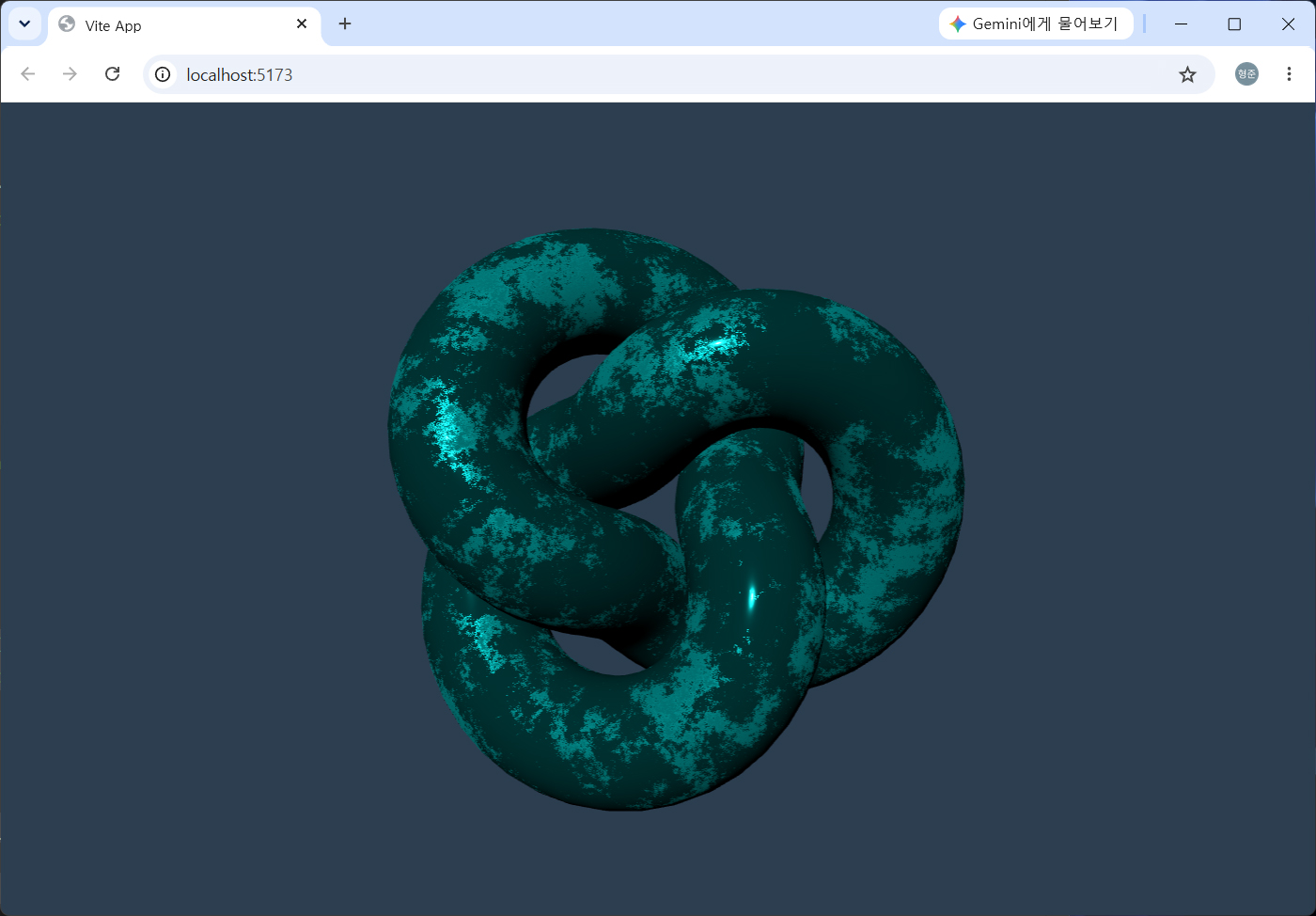
three.js 쉐이더 언어인 TSL에서 물리적 광원에 대한 개별 노드를 지정하는 방식을 정리해 봅니다. TSL을 통해 표현하고자 하는 재질은 다음과 같습니다.

코드는 다음과 같습니다.

const geometry = new THREE.IcosahedronGeometry(1, 64);
const material = new THREE.MeshStandardNodeMaterial({
  color: "black",
  // wireframe: true,
});
const mesh = new THREE.Mesh(geometry, material)

const path = './Metal053B_2K-JPG';

const texColor = new THREE.TextureLoader().load(`${path}/Metal053B_2K-JPG_Color.jpg`);
material.colorNode = texture(texColor);

const texNormal = new THREE.TextureLoader().load(`${path}/Metal053B_2K-JPG_NormalGL.jpg`);
material.normalNode = normalMap(texture(texNormal), float(1.));

const texMetalness = new THREE.TextureLoader().load(`${path}/Metal053B_2K-JPG_Metalness.jpg`);
material.metalnessNode = mul(texture(texMetalness), 1.);

const texRoughness = new THREE.TextureLoader().load(`${path}/Metal053B_2K-JPG_Roughness.jpg`);
material.roughnessNode = mul(texture(texRoughness), float(0.7));

광원 노드에 집중하기 위해서 텍스쳐 데이터를 사용했습니다. 텍스쳐 본연의 표현을 위해 재질의 기본 색상을 블랙으로 지정했구요. 사용한 노드는 colorNode, normalNode, metalnessNode, roughnessNode입니다.

광원에 대한 노드는 아니지만 Displacement에 대한 노드를 알아보기 위해 표현하고자 하는 재질은 다음과 같습니다.

코드는 다음과 같습니다.

const geometry = new THREE.IcosahedronGeometry(1, 64);
const material = new THREE.MeshStandardNodeMaterial({
  color: "black",
  // wireframe: true,
});
const mesh = new THREE.Mesh(geometry, material)

const path = './Rock058_2K-JPG';

...

const texAO = new THREE.TextureLoader().load(`${path}/Rock058_2K-JPG_AmbientOcclusion.jpg`);
geometry.setAttribute('uv2', new THREE.BufferAttribute(geometry.attributes.uv.array, 2));
material.aoNode = mul(texture(texAO), float(1.));

const texDisplacement = new THREE.TextureLoader().load(`${path}/Rock058_2K-JPG_Displacement.jpg`);
const displacementNode = texture(texDisplacement);
const displaceStrength = 0.3;
const displacementValue = displacementNode.r.sub(0.5).mul(displaceStrength);
const newPosition = positionWorld.add(normalLocal.mul(displacementValue));
material.positionNode = newPosition;

Displacement 표현을 위해서는 Vertex Shader에 해당하는 positionNode를 이용해야 합니다. 추가로 AO 노드에 대한 사용 코드도 보입니다.

R3F Cookbook

R3F는 React 기반에서 three.js를 매우 직관적이고 사용하기 쉬운 컴포넌트 레벨로 개발할 수 있는 패키지입니다. 아래의 영상은 R3F에서 제공하는 컴포넌트, 클래스 등과 R3F를 위한 보다 더 발전된 컴포넌트를 제공하는 drei에 대한 내용을 설명합니다. 이 영상 제작의 목적은 궁극적으로 drei의 컴포넌트를 이해하고 이러한 컴포넌트를 직접 개발하기 위한 지식을 얻기 위함입니다.

위의 영상에 더해 지속적으로 내용이 업데이트되므로 해당 채널에 방문하여 참고하시기 바랍니다.

이웃 격자 밖으로 출력된 결과에 대한 자연스러운 처리

  ..
  
  float n = Hash21(id);
  col += Star(gv - vec2(n, fract(n * 34.)) + .5, 1.);
  
  ..

위의 결과를 보면 격자 하나에 대해 어떤 형상 하나가 표시되어 있다. 문제는 형상 하나가 외부 격자 밖에서는 짤려나간다는 것인데, 이를 해결하기 위한 코드가 아래와 같다.

  ..
  
  for(int y=-1; y<=1; y++) {
      for(int x=-1; x<=1; x++) {
        vec2 offs = vec2(x, y);
        
        float n = Hash21(id + offs);
        col += Star(gv - offs - vec2(n, fract(n * 34.)) + .5, 1.);
      }
  }
  
  ..

위의 코드에서 유의해야할 점은 형상 하나가 바로 인접한 이웃의 이웃 밖으로 나갈 경우 처리되지 않는다. 이럴때는 밖으로 나간 것까지 포함되도록 for 문의 반복 범위를 확장해야 한다.

전체 코드는 다음과 같다.

uniform vec3 uResolution;
uniform float uTime;
uniform vec4 uMouse;

mat2 Rot(float a) {
  float s = sin(a);
  float c = cos(a);
  return mat2(c, -s, s, c);
}

float Star(vec2 uv, float flare) {
  float d = length(uv);
  float m = .05 / d;
  
  float rays = max(0., 1. - abs(uv.x * uv.y * 1000.));
  m += rays * flare;
  uv *= Rot(3.1415 / 4.); 
  rays = max(0., 1. - abs(uv.x * uv.y * 1000.));
  m += rays * .3 * flare;

  m *= smoothstep(1., .0, d); // 형상 하나가 바로 인접한 이웃 밖으로 나가지 않도록 해주는 코드

  return m; 
}

float Hash21(vec2 p) {
  p = fract(p * vec2(123.34, 456.21));
  p += dot(p, p + 45.32);
  return fract(p.x * p.y);
}

void main() {
  vec2 uv = (gl_FragCoord.xy - .5 * uResolution.xy) / uResolution.y;
  uv *= 3.;

  vec3 col = vec3(0);

  vec2 gv = fract(uv) - .5;
  vec2 id = floor(uv);

  for(int y=-1; y<=1; y++) {
      for(int x=-1; x<=1; x++) {
        vec2 offs = vec2(x, y);
        
        float n = Hash21(id + offs);
        col += Star(gv - offs - vec2(n, fract(n * 34.)) + .5, 1.);
      }
  }

  if(gv.x > .48 || gv.y > .48) col.r = 1.;  

  gl_FragColor = vec4(col, 1.0);
}

GLSL 퀵 레퍼런스

어떤 지점(p)에서 Ray(r)에 가장 가까운 r 위의 좌표 얻기

struct ray {
  vec3 o, d;
};

vec3 ClosestPoint(ray r, vec3 p) {
  return r.o + max(0., dot(p-r.o, r.d)) * r.d;
}

위의 ClosePoint를 이용하면 ray와 어떤 지점에 대한 최단 거리를 아래 함수를 이용해 구할 수 있다.

float DistRay(ray r, vec3 p) {
  return length(p - ClosestPoint(r, p));
}

선 그리기 함수

float line(vec2 p, vec2 a, vec2 b) {
  vec2 pa = p - a, ba = b - a;
  float t = clamp(dot(pa, ba)/dot(ba, ba), 0., 1.);
  vec2 c = a + ba * t;
  float d = length(c - p);
  return smoothstep(fwidth(d), 0., d - .001);
}

0 ~ 1 사이의 값을 갖는 간단한 노이즈 함수

float random (in vec2 st) {
    return fract(sin(dot(st.xy,
        vec2(12.9898,78.233)))*
        43758.5453123);
}

// Based on Morgan McGuire @morgan3d
// https://www.shadertoy.com/view/4dS3Wd
float noise (in vec2 st) {
    vec2 i = floor(st);
    vec2 f = fract(st);

    // Four corners in 2D of a tile
    float a = random(i);
    float b = random(i + vec2(1.0, 0.0));
    float c = random(i + vec2(0.0, 1.0));
    float d = random(i + vec2(1.0, 1.0));

    vec2 u = f * f * (3.0 - 2.0 * f);

    return mix(a, b, u.x) +
            (c - a)* u.y * (1.0 - u.x) +
            (d - b) * u.x * u.y;
}

-1 ~ 1 사이의 값을 갖는 Simplex 노이즈 함수

// Some useful functions
vec3 mod289(vec3 x) { return x - floor(x * (1.0 / 289.0)) * 289.0; }
vec2 mod289(vec2 x) { return x - floor(x * (1.0 / 289.0)) * 289.0; }
vec3 permute(vec3 x) { return mod289(((x*34.0)+1.0)*x); }

//
// Description : GLSL 2D simplex noise function
//      Author : Ian McEwan, Ashima Arts
//  Maintainer : ijm
//     Lastmod : 20110822 (ijm)
//     License :
//  Copyright (C) 2011 Ashima Arts. All rights reserved.
//  Distributed under the MIT License. See LICENSE file.
//  https://github.com/ashima/webgl-noise
//
float snoise(vec2 v) {

    // Precompute values for skewed triangular grid
    const vec4 C = vec4(0.211324865405187,
                        // (3.0-sqrt(3.0))/6.0
                        0.366025403784439,
                        // 0.5*(sqrt(3.0)-1.0)
                        -0.577350269189626,
                        // -1.0 + 2.0 * C.x
                        0.024390243902439);
                        // 1.0 / 41.0

    // First corner (x0)
    vec2 i  = floor(v + dot(v, C.yy));
    vec2 x0 = v - i + dot(i, C.xx);

    // Other two corners (x1, x2)
    vec2 i1 = vec2(0.0);
    i1 = (x0.x > x0.y)? vec2(1.0, 0.0):vec2(0.0, 1.0);
    vec2 x1 = x0.xy + C.xx - i1;
    vec2 x2 = x0.xy + C.zz;

    // Do some permutations to avoid
    // truncation effects in permutation
    i = mod289(i);
    vec3 p = permute(
            permute( i.y + vec3(0.0, i1.y, 1.0))
                + i.x + vec3(0.0, i1.x, 1.0 ));

    vec3 m = max(0.5 - vec3(
                        dot(x0,x0),
                        dot(x1,x1),
                        dot(x2,x2)
                        ), 0.0);

    m = m*m ;
    m = m*m ;

    // Gradients:
    //  41 pts uniformly over a line, mapped onto a diamond
    //  The ring size 17*17 = 289 is close to a multiple
    //      of 41 (41*7 = 287)

    vec3 x = 2.0 * fract(p * C.www) - 1.0;
    vec3 h = abs(x) - 0.5;
    vec3 ox = floor(x + 0.5);
    vec3 a0 = x - ox;

    // Normalise gradients implicitly by scaling m
    // Approximation of: m *= inversesqrt(a0*a0 + h*h);
    m *= 1.79284291400159 - 0.85373472095314 * (a0*a0+h*h);

    // Compute final noise value at P
    vec3 g = vec3(0.0);
    g.x  = a0.x  * x0.x  + h.x  * x0.y;
    g.yz = a0.yz * vec2(x1.x,x2.x) + h.yz * vec2(x1.y,x2.y);
    return 130.0 * dot(m, g);
}

좀더 고른 분포의 랜던 hash

uvec2 murmurHash21(uint src) {
  const uint M = 0x5bd1e995u;
  uvec2 h = uvec2(1190494759u, 2147483647u);
  src *= M;
  src ^= src>>24u;
  src *= M;
  h *= M;
  h ^= src;
  h ^= h>>13u;
  h *= M;
  h ^= h>>15u;
  return h;
}

// 2 outputs, 1 input
vec2 hash21(float src) {
  uvec2 h = murmurHash21(floatBitsToUint(src));
  return uintBitsToFloat(h & 0x007fffffu | 0x3f800000u) - 1.0;
}

smoothstep의 보간식

아래의 a와 b는 동일한 값이다.

float f = uv.x;
float a = smoothstep(0., 1., f);
float b = f * f * (3. - 2. * f);

위의 보간식을 cubic Hermite curve(큐빅 헤르미트 곡선)라고 한다. 0~1 사이의 영역에서 시작과 끝을 좀더 편평하게 만들어주는 quintic interpolation cuver(퀸틱 보간 곡선)에 대한 코드는 다음과 같다.

float f = uv.x;
float b = f * f * f * (6. * f * f - 15. * f + 10.);

modelMatrix로 변환된 normal 얻기

varying vec3 vNormal;

...

vNormal = mat3(transpose(inverse(modelMatrix))) * normal;

프레그먼트 쉐이더에서는 받은 vNormal을 반드시 정규화(normalize)해야 한다.

3초 주기로 0 ~ 1 사이의 연속된 값 얻기

uniform float u_time; // 0, 1, 2, ...의 값이며 각각 0초, 1초, 2초, ...를 나타냄

...

float period = 3.; // 3초 주기
float t = mod(u_time, period) / period; // 0 ~ 1 사이의 연속된 값

// sin 함수에 3.1415를 곱하는 이유는 sin 함수의 한 주기가 360도이기 때문임
vec3 color = mix(vec3(0), vec3(1), abs(sin(3.1415 * t)));
// or
vec3 color = mix(vec3(0), vec3(1), sin(3.1415 * t) * .5 + .5); 

원하는 각도를 이루는 선

아래의 이미지는 45도를 이루는 선인데, 이처럼 원하는 각도를 이루는 선을 만들기 위한 코드이다.

uniform vec3 uResolution;
uniform float uTime;
uniform vec4 uMouse;

#define PI (3.141592)

void main() {
  vec2 st = gl_FragCoord.xy / uResolution.xy;
  st = (gl_FragCoord.xy - .5 * uResolution.xy) / uResolution.y;

  float w = fwidth(st.y);
  float a = (45.) * PI / 180.0;
  float d = dot(st, vec2(cos(a), sin(a)));
  d = smoothstep(-w, w, abs(d));

  gl_FragColor = vec4(vec3(1. - d), 1.);
}

다각형 그리기

uniform vec3 uResolution;
uniform float uTime;
uniform vec4 uMouse;

#define PI 3.14159265359
#define TWO_PI 6.28318530718

void main(){
  vec2 st = gl_FragCoord.xy/uResolution.xy * 2. - 1.; //-1-1
  st.x *= uResolution.x/uResolution.y;
  vec3 color = vec3(0.0);
  float d = 0.0;

  // Number of sides of your shape
  int N = 6;
  // int N = int(floor(mod(uTime * 10., 20.))) + 3;

  // Angle and radius from the current pixel
  float a = atan(st.x,st.y)+PI;
  float r = TWO_PI/float(N);

  // Shaping function that modulate the distance
  d = cos(floor(.5+a/r)*r-a)*length(st);

  // color = vec3(d); // Distance Field
  color = vec3(1.0-step(.5, d)); // Fill
  // color = vec3(step(.5,d) * step(d,.51)); // Only outline

  gl_FragColor = vec4(color,1.0);
}